Change Management
T𝗵𝗲 𝗠𝗼𝘀𝘁 𝗨𝗻𝗱𝗲𝗿𝗳𝘂𝗻𝗱𝗲𝗱 𝗟𝗶𝗻𝗲 𝗜𝘁𝗲𝗺 𝗶𝗻 𝗔𝗜 𝗮𝗻𝗱 𝗥𝗣𝗔 𝗣𝗿𝗼𝗷𝗲𝗰𝘁𝘀
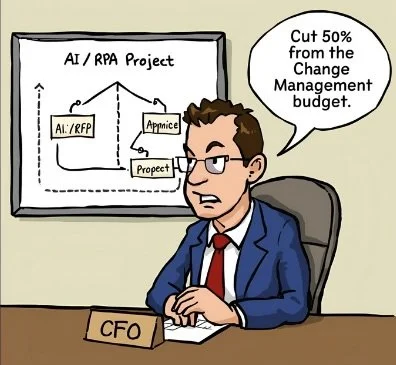
What could go wrong!?
In nearly every AI or RPA-enabled transformation, there's one line item that gets quietly trimmed during budget reviews, and it's usually the one that determines whether the entire initiative succeeds.
That line item is Change Management.
The failure rates are staggering across all AI types. The now famous research from MIT Center for Information Systems Research (CISR) found that 95% of generative AI pilots fail to deliver measurable P&L impact. For agentic AI, systems that can act autonomously across business processes, the challenges intensify. Gartner predicts over 40% of agentic AI projects will be canceled by 2027, often before they even reach deployment due to escalating costs and inadequate risk controls.
The primary culprit? Not technical limitations, but flawed integration with existing workflows and inadequate organizational readiness.
Executives are rightly cautious with transformation budgets. They want capital to go toward tangible outcomes: automated workflows, AI-powered insights, process acceleration. What they don't want, often instinctively, is to spend on what looks like the soft stuff.
But here's the reality: generative AI requires humans to trust machine-generated insights. Agentic AI goes further as it requires organizations to let machines make decisions and take actions independently. When the technology is built, the processes are redesigned, and the platform is live, the real challenge begins.
People. Trust. Behavior. Adoption. Accountability. Governance. These are the levers that determine if you actually capture the value you just built, and they become exponentially more complex as AI moves from assistance to autonomy.
𝗧𝗵𝗲 𝗕𝗶𝗮𝘀 𝗶𝘀 𝗥𝗲𝗮𝗹
CFOs and executive sponsors are often wired to prioritize execution. That's not wrong, but it creates a recurring blind spot:
Change management gets lumped in with training or internal communications
It's seen as overhead instead of a success multiplier
The assumption is: 'If we build the right solution, they'll use it'
This logic may hold for traditional infrastructure upgrades but it does not hold when you're changing how people work, how decisions are made, or what tasks are automated.
𝗪𝗵𝘆 𝗔𝗜 𝗮𝗻𝗱 𝗥𝗣𝗔 𝗔𝗿𝗲 𝗗𝗶𝗳𝗳𝗲𝗿𝗲𝗻𝘁
AI and RPA initiatives don't just improve workflows. They redefine roles, introduce machine decision-making, and shift ownership of process outcomes. That level of impact requires deeper understanding at the human level and triggers real resistance.
𝗧𝗵𝗲 𝗤𝘂𝗲𝘀𝘁𝗶𝗼𝗻𝘀 𝗧𝗵𝗮𝘁 𝗞𝗶𝗹𝗹 𝗔𝗱𝗼𝗽𝘁𝗶𝗼𝗻
Is this replacing my job?
Can I trust this model?
Who owns the exceptions?
What happens when it's wrong?
These are not edge cases. These are the conversations that happen every day in AI and automation deployments. And they don't get solved with a single training session or launch email.
𝗦𝗼, 𝗪𝗵𝗮𝘁 𝗦𝗵𝗼𝘂𝗹𝗱 𝗬𝗼𝘂 𝗔𝗹𝗹𝗼𝗰𝗮𝘁𝗲?
For transformation projects that involve RPA or AI, change management should account for 20 to 35 percent of the total project budget.
Yes, that's higher than most traditional IT initiatives. For comparison: traditional IT projects typically allocate 10-15% to change management, while ERP implementations run 15-20%. AI and RPA require 20-35% because you're not just changing systems - you're changing decision-making authority.
𝗛𝗲𝗿𝗲'𝘀 𝘄𝗵𝘆 𝗶𝘁 𝗺𝗮𝗸𝗲𝘀 𝘀𝗲𝗻𝘀𝗲
You're not just launching a tool. You're minimally shifting the operating model and may be implementing a new Target Operating Model.
You need to manage stakeholder fear, cross-functional complexity, and governance
You must build trust in a system that makes decisions previously owned by people
You're introducing workflows that blur departmental lines and challenge existing KPIs
This level of change requires structured communication, upskilling, workflow testing, oversight design, data transparency, policy updates, and executive alignment.
𝗦𝘁𝗶𝗹𝗹 𝗦𝗼𝘂𝗻𝗱 𝗛𝗶𝗴𝗵?
Here's the real question: What does it cost when you don't do it?
The typical mid-market company invests $500K-$2M in AI/RPA initiatives. When adoption fails, you don't just lose the technology investment - you lose credibility and momentum for the next transformation.
AI models get ignored because no one trusts the output
RPA fails to scale beyond the initial pilot
Shadow processes re-emerge because the new system doesn't work for us
Your transformation ROI slides off the deck before year-end
Change management is not a feel-good insurance policy. It is the delivery mechanism for the ROI you just invested in building.
𝗥𝗲𝗳𝗿𝗮𝗺𝗶𝗻𝗴 𝘁𝗵𝗲 𝗦𝗽𝗲𝗻𝗱
Instead of debating whether change management deserves 25 or 30 percent of the budget, reframe the conversation.
What is the cost of wasted effort, abandoned tools, misaligned workflows, and disengaged employees? The change program isn't separate from the transformation. It is what makes the transformation real.
Look through the lens of mitigating blockers to acceptance. Itemize the activities in Change Management (AI fluency training, feedback loops and adoption tracking, executive messaging, stakeholder alignment, policy updates, etc.).
If the technology is the engine, change management is the transmission. Without it, the vehicle doesn't move.
𝗕𝗲𝗳𝗼𝗿𝗲 𝗬𝗼𝘂 𝗟𝗮𝘂𝗻𝗰𝗵
If you're planning an AI or RPA initiative in the next 6 months, ask these three questions before you finalize the budget:
What are the blockers to adoption? Define them and mitigate them.
Who's owning the change? Not just training - the full organizational transition.
What's the change management budget? If it's under 15% of total project cost, you're at risk.
How will you measure adoption success? Beyond system metrics - actual workflow and decision-making changes.
If any answer is unclear, the project is already at risk. Let's talk.